
Moving to Europe for work is one of the most common — and most confusing — relocation goals for job seekers worldwide. Every country has its own rules, its own paperwork, and its own timeline, but the underlying process follows a pattern once you understand it.
This guide breaks that pattern down: what a work visa actually is, which type applies to you, what documents you’ll need, and how the process usually unfolds from job offer to arrival. Below, you’ll also find links to our country-specific guides, which go deeper into the exact requirements for Poland, Lithuania, Malta, Romania, Finland, Hungary, and more.
Not sure where you’d even qualify? Try our Free Visa Predictor to see which countries match your profile before you read further.
1. Work Visa vs. Work Permit vs. Residence Permit
These three terms get used interchangeably, but they’re not the same thing — and mixing them up is one of the most common sources of confusion for first-time applicants.
- Work visa: The document that lets you enter the country for employment purposes. It’s usually a sticker or stamp in your passport, issued by the embassy or consulate in your home country.
- Work permit: The authorization that lets you legally work for a specific employer, often applied for by the employer itself, sometimes before you apply for the visa.
- Residence permit: The document that lets you stay in the country beyond the visa’s short-term validity — typically applied for after you arrive, and it’s what you’ll renew annually or biannually.
In many European countries, these three steps are bundled into a single combined application (Poland and Lithuania both do this, for example). In others, they’re three separate applications handled by different offices.
2. Do You Need a Visa to Work in Europe?
It depends entirely on your nationality and the country you’re targeting.
- EU/EEA/Swiss citizens can work in any EU or EEA member state without a visa or work permit, thanks to freedom of movement.
- Non-EU/non-EEA citizens almost always need both a work permit and a visa, unless a specific bilateral agreement applies.
- UK citizens, post-Brexit, are treated as non-EU nationals and need a visa/permit for any EU country.
If you’re a non-EU national, the question isn’t whether you need a visa — it’s which type, and whether the country you’re targeting has a favorable quota, shortage-occupation list, or seasonal program you can use to your advantage. That’s covered next.
3. Types of European Work Visas
Most European work visas fall into one of these categories:
- General/national work visa — tied to a specific job offer and employer, usually requiring a labor market test (proof no local/EU candidate could fill the role).
- EU Blue Card — for highly skilled workers with a university degree and a qualifying salary threshold. See section 4.
- Seasonal work visa — shorter-term, common in agriculture, hospitality, and tourism (Germany, Portugal, and Italy all run active seasonal programs).
- Intra-company transfer (ICT) visa — for employees relocated within the same multinational company.
- Self-employment/freelance visa — for entrepreneurs and freelancers, available in countries like Portugal, Germany, and Estonia.
- Shortage occupation visa — fast-tracked visas for roles on a country’s official labor shortage list (common in Lithuania, Poland, and Romania for logistics, manufacturing, and hospitality roles).
Which category applies to you depends on your qualifications, job offer, and target country — this is exactly what our Visa Predictor tool is built to sort out in a couple of minutes.
4. The EU Blue Card, Explained
The EU Blue Card is the closest thing Europe has to a unified skilled-worker visa. It’s issued by individual member states but follows shared EU-wide rules, and it’s generally the strongest option if you qualify.
Typical requirements:
- A university degree (or, in some countries, 5+ years of equivalent professional experience)
- A binding job offer or employment contract
- A salary meeting the national Blue Card threshold (varies by country, generally 1.0–1.5x the average national salary)
Why it’s attractive:
- Faster processing in most member states
- Easier family reunification
- A more direct path to long-term residence and EU mobility after a few years
Not every country participates identically — Germany, France, and the Netherlands have well-established Blue Card pathways, while smaller states may have narrower quotas. Check your target country’s guide for specifics.
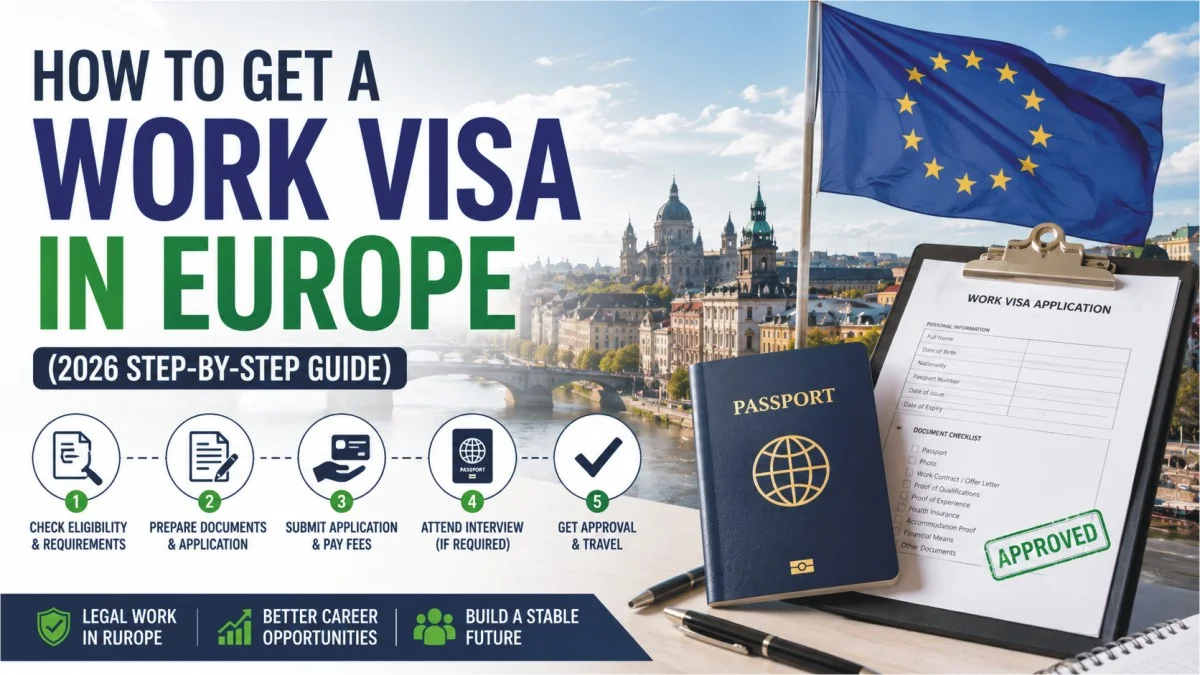
5. Step-by-Step: How the Work Visa Process Works
While the details vary by country, the sequence is remarkably consistent:
- Secure a job offer or employment contract. Almost every European work visa route requires this first — Europe is not generally a “move first, find work later” region for non-EU nationals.
- Employer applies for a work permit (if required). In many countries, your future employer initiates this step with the local labor office before you apply for a visa.
- Gather your documents. See the full checklist below.
- Apply for the visa at your home country’s embassy or consulate. This is where most of the waiting happens.
- Attend a visa interview or biometrics appointment, if required.
- Receive your visa and travel. Entry visas are often valid for 90 days; you’ll need to register locally shortly after arrival.
- Apply for your residence permit (if not already combined with your visa) within the required window after arrival — usually 30 to 90 days depending on the country.
6. Documents You’ll Almost Always Need
Requirements vary, but nearly every European work visa application asks for:
- Valid passport (usually with 6+ months validity remaining)
- Signed employment contract or job offer letter
- Proof of qualifications (degree certificates, professional licenses)
- CV/resume in the required format — our Free CV Maker generates a European-style CV that matches what employers and embassies expect
- Proof of accommodation in the destination country
- Proof of sufficient funds/financial means
- Health insurance covering the destination country
- Clean criminal record certificate
- Passport-sized photos meeting Schengen photo requirements
- Visa application form and fee payment receipt
Some countries add extras — a labor market test result, a certified translation of documents, or a police clearance apostille. Country-specific guides note these where they apply.
7. How Long Does It Take?
Realistic ranges, from job offer to arrival:
- Fast-track/shortage-occupation routes: 4–8 weeks
- Standard national work visas: 2–4 months
- EU Blue Card: 1–3 months, depending on the country
- Seasonal work visas: 2–6 weeks (often expedited given the time-limited nature of the work)
Processing times fluctuate with embassy backlog and application volume — always check current wait times for your specific consulate before making commitments like resigning from your current job.
8. Easiest European Countries to Get a Work Visa
Based on labor shortages, faster processing, and lower salary thresholds, these countries currently offer some of the more accessible routes for non-EU applicants:
- Poland — large labor market, well-established process for non-EU workers, strong demand in manufacturing and logistics
- Lithuania — active shortage-occupation lists, growing demand in agriculture, delivery, and food processing
- Romania — expanding work permit quotas, strong demand in construction and security
- Malta — active hospitality and tourism sector hiring
- Finland — seasonal and delivery-sector demand, transparent application process
These rankings shift as quotas and shortage lists update each year — our News section tracks changes as they happen.
9. Country-by-Country Hiring Events
- Check Out the Upcoming Recruitment events where work visa is being sponsored by the hiring companies.
10. Common Mistakes That Get Applications Rejected
- Applying before securing a job offer — most European work visas require this as a prerequisite, not an afterthought.
- Incomplete or inconsistent documentation — names, dates, and job titles must match exactly across your contract, CV, and application form.
- Underestimating processing time — applying too close to an intended start date is one of the most common avoidable mistakes.
- Ignoring the salary threshold — especially relevant for Blue Card applicants; an offer below the minimum threshold results in automatic rejection.
- Missing the residence permit registration window after arrival — visa approval isn’t the finish line.
11. FAQs
Can I apply for a European work visa without a job offer? In almost all cases, no. Nearly every non-EU work visa route in Europe requires a signed job offer or contract before you can apply.
Can I switch employers after getting a work visa? This depends on the country and visa type. Some work visas are tied to a specific employer for the first year; others allow switching immediately. Check the relevant country guide.
Is the EU Blue Card better than a national work visa? For skilled workers who qualify, generally yes — it offers faster mobility within the EU and an easier path to long-term residence. But not every job or salary level qualifies.
How much does a European work visa cost? Visa fees typically range from €60–€180, though total relocation costs (documents, translations, insurance, travel) are usually higher. Country guides include current fee breakdowns.
Which European country is easiest to get a work visa for right now? This changes as shortage-occupation lists and quotas update. Use our Visa Predictor for a personalized answer based on your profile, or check our current job openings by country for active demand.
Ready to see where you stand? Run your profile through our Free Visa Predictor, build a European-style CV with our Free CV Maker, and browse current job openings across Europe.