
Europe Tourist Visa Approval Predictor 2026
Instantly assess your Schengen and European visa approval chances based on the same criteria embassies actually use.
Getting a European tourist visa refused doesn’t just cost you money, it damages your future applications.
Embassy Visa Officers evaluate dozens of factors in minutes. Your financial strength, travel history, home country ties, document quality and nationality risk profile. This free tool applies the same weighted assessment logic to your profile and gives you an honest probability score, warnings and actionable steps to strengthen your application before you submit — across all 44 European countries including all Schengen states.
- Based on publicly available Legal Framework Schengen Code criteria
- Covers all 44 European countries including non-Schengen
- No personal data stored — fully private assessment
A Smart Travel Tool by EuropeObserver.net
Will Your Europe Visa
Get Approved?
Our AI engine evaluates your profile against 30+ factors used by European embassies — instantly and privately.
Ready to analyse your application?
Europe Observer AI engine will evaluate your profile across 30+ factors used by European embassies and give you a personalised approval probability with detailed recommendations.
| Country | Your Chance | Likelihood | Difficulty | Recommendation |
|---|
Important Disclaimer: This tool provides estimated probabilities based on common visa assessment factors and publicly available embassy information. Actual approval decisions are made solely by embassies and consulates. This is not legal advice. Consult a licensed immigration professional for your specific situation.
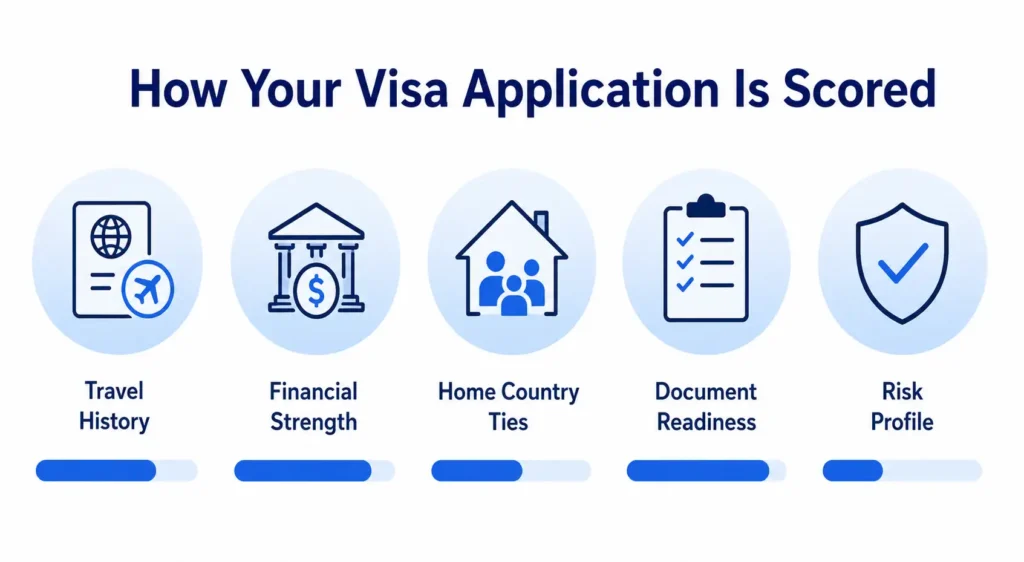
How European Visa Officers Actually Assess Your Application
When a visa officer opens your file, they are not reading it hoping to approve you. They are looking for reasons to refuse. The Schengen Visa Code (Regulation EU 810/2009) defines the legal framework, but the practical assessment is based on a risk matrix that weighs five core pillars.
- Financial Sufficiency is the first filter. Officers check whether you can fund your stay without working illegally and whether you have enough reserves to handle emergencies. Most Schengen countries expect a minimum of €50–€100 per day of stay, plus a buffer. A bank balance that only covers your exact trip budget raises immediate suspicion.
- Home Country Ties is arguably the most important factor after finances. The fundamental question officers are answering is: “Will this person leave when their visa expires?” Strong ties — a stable job, property, dependent family members, a running business — provide evidence that you have compelling reasons to return home. Weak ties with no property, no stable employment and no dependents are the leading cause of refusals among first time applicants.
- Travel History serves as a trust signal. An applicant who has traveled to 15 countries and always returned on time is statistically lower risk than someone applying for their first international trip. Prior Schengen or European visas carry particular weight — they demonstrate that another embassy already assessed and approved you.
- Document Quality and Completeness signals preparation and intent. A disorganized, incomplete application suggests either lack of seriousness or an attempt to hide something. A complete, well ordered file with a clear cover letter and day to day itinerary shows a genuine tourist.
- Nationality and Residence Risk Profile is the factor applicants have the least control over. Certain nationalities face higher default scrutiny not due to individual characteristics but due to aggregate overstay and irregular migration statistics. Applicants from high-scrutiny countries need correspondingly stronger evidence in all other categories.
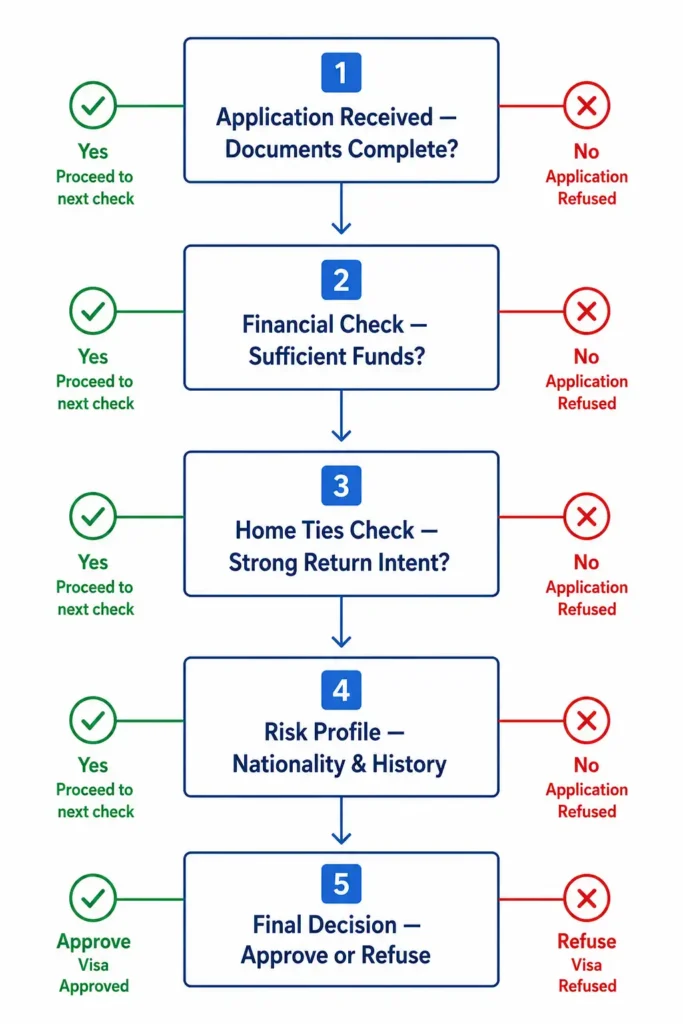
Schengen Visa Requirements — What You Actually Need in 2026
The following documents are mandatory for all Schengen visa applications regardless of destination country:
Valid Passport — Must be issued within the last 10 years and have at least 3 months validity beyond your intended departure from the Schengen area. Two blank pages are required.
Application Form — Completed online via the VFS Global or relevant consulate portal, signed by hand or digitally depending on the consulate.
Recent Passport Photographs — Two photos taken within the last 6 months, 35mm × 45mm, white background, no glasses.
Travel Insurance — Minimum coverage of €30,000 for medical emergencies and repatriation, valid for the entire Schengen area for the full duration of your stay. This is non-negotiable and frequently the single most overlooked document.
Proof of Accommodation — Hotel booking confirmations, Airbnb reservations, or a notarized invitation letter from a host. The accommodation must be booked for every night of your stay.
Flight Itinerary — Return flight reservation showing entry and exit. Most applicants use a dummy ticket reservation service rather than purchasing tickets before visa approval.
Proof of Financial Means — Bank statements for the last 3–6 months showing consistent balance and regular income. Sudden large deposits before the application are a red flag. Salary slips, tax returns, and employer letters support the financial case.
Employment Documentation — An official letter from your employer on company letterhead confirming your position, salary, length of employment, and approved leave dates. Self-employed applicants need business registration certificates, tax returns, and a letter from an accountant.
Cover Letter — A personal statement explaining the purpose and itinerary of your trip, why you will return home, and your ties to your home country. Underused by most applicants and one of the highest-impact documents in a borderline application.
Which European Countries Are Easiest to Get a Tourist Visa?
Europe is not one visa system. It is a collection of 44 countries with vastly different entry requirements, approval rates, financial thresholds, and attitudes toward first-time applicants from high-scrutiny nationalities. Understanding where your profile fits best can be the difference between a stamp in your passport and a refusal letter.
Easiest European Countries for First-Time Applicants
Georgia requires no visa at all for citizens of over 90 countries, allowing stays of up to 365 days. For nationalities that do require a visa, Georgia’s e-visa system has an extremely high approval rate and minimal financial requirements. It is one of the most accessible European destinations on the continent and an excellent first international trip for building travel history.
Albania operates a visa-free policy for citizens of most countries between April and October as a seasonal tourism measure, and issues visas with minimal friction for those who do require them. Financial thresholds are among the lowest in Europe.
Serbia is visa-free for over 60 nationalities and offers straightforward visa-on-arrival or e-visa options for others. Serbia does not require proof of onward travel or minimum bank balances at the level Schengen countries demand.
North Macedonia, Montenegro and Bosnia and Herzegovina operate similarly accessible entry systems. All three are actively developing tourism infrastructure and present very low barriers for genuine tourists regardless of nationality or travel history.
Turkey offers an e-visa system covering over 100 nationalities at low cost with near-automatic approval for most applicants. Financial scrutiny is minimal and processing takes minutes online.
Moldova and Kosovo maintain simple, accessible entry requirements with low refusal rates and minimal documentation demands.
Romania and Bulgaria joined the Schengen Area in January 2024 for air and sea travel, with full land border integration ongoing. However, their consular networks still process applications with relatively accessible requirements compared to older Schengen members like Germany or Switzerland. Both remain good entry points for first-time Schengen applicants who have moderate financial profiles and complete documentation.
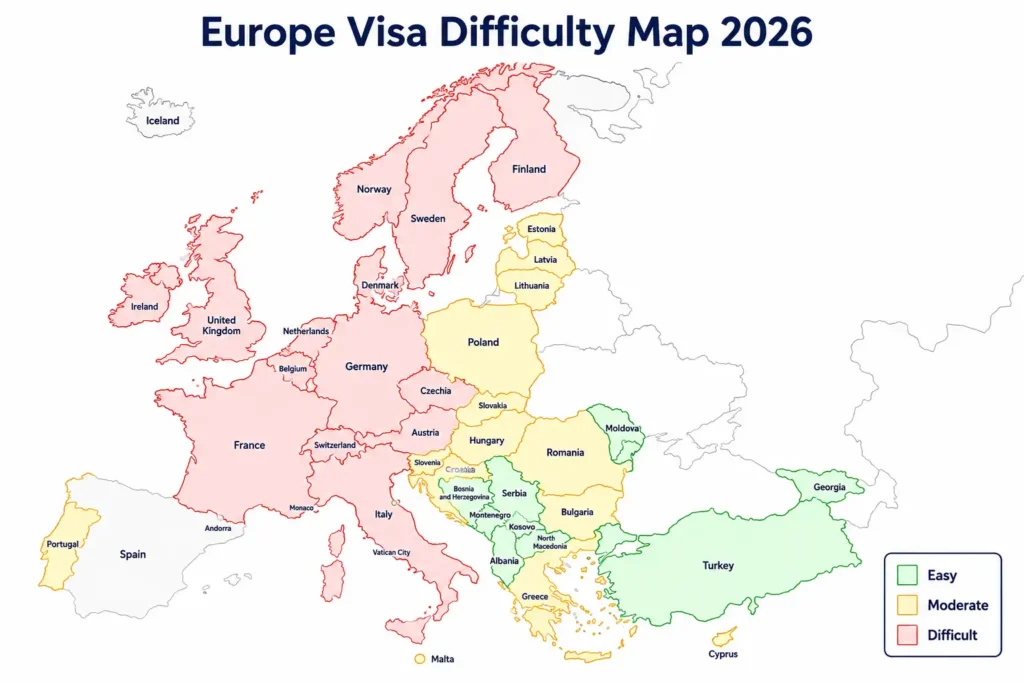
Mid-Tier Difficulty — Good Options With a Solid Application
Greece consistently maintains one of the highest approval rates among Schengen states, particularly for tourism applicants during peak season between May and October. Financial thresholds are applied with more flexibility than northern European counterparts.
Portugal has become increasingly tourism-friendly and first-time applicants with moderate financial profiles and complete documentation tend to receive favorable outcomes.
Poland, Estonia, Latvia, and Lithuania process applications efficiently with transparent requirements and lower financial thresholds than Western European members. All four are excellent entry points for building a Schengen visa history.
Malta and Slovenia have smaller consular networks but historically strong approval rates for genuine tourism applications.
Croatia joined Schengen in January 2023 and its consular network is still scaling. Processing tends to be faster and less scrutinized than older Schengen members.
Cyprus and Ireland remain outside the Schengen Area with their own national visa systems. Both are accessible compared to core Schengen countries but require separate applications if visiting alongside Schengen destinations.
San Marino, Monaco, Andorra, and Vatican City are micro-states that do not issue their own tourist visas — access requires a valid Schengen visa or the visa of the surrounding country.
Most Difficult — Require Strong Applications
Switzerland applies the strictest financial scrutiny of any European country. Daily budget expectations exceed €150 and bank statements receive detailed line-by-line analysis.
Inconsistencies between stated income and accumulated savings trigger automatic additional scrutiny. First-time applicants from high-scrutiny nationalities should build a strong Schengen visa history before applying to Switzerland.
Germany has the highest volume of visa applications globally and applies systematic risk profiling. Incomplete applications are refused without opportunity to supplement. Employment letters must be on official letterhead and your declared income must demonstrably cover both your normal home living expenses and the trip simultaneously.
Denmark, Norway, Sweden, and Finland apply thorough document checks and expect clean financial histories with no gaps, unexplained transactions or sudden balance changes in the months before application.
France and Netherlands process high volumes and apply medium-high scrutiny, with accommodation and itinerary consistency checks being particularly common areas of refusal.
United Kingdom operates a completely separate visa system post-Brexit with its own requirements, biometric enrollment, and financial thresholds. A Schengen visa provides no access to the UK and the two systems must be applied for independently.
Belarus technically exists as a European destination but carries significant travel advisories from most Western governments. Entry is possible but not recommended for most nationalities at this time given the current geopolitical situation.
Why Visa Applications Get Refused — The Most Common Rejection Reasons
Understanding refusal reasons is more practically useful than understanding approval criteria, because refusals follow predictable patterns.
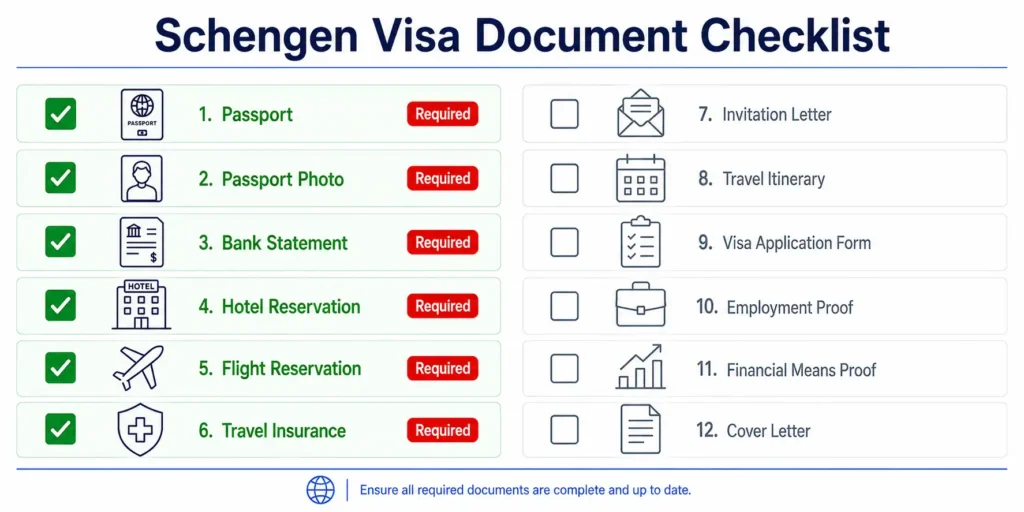
Insufficient Financial Evidence accounts for roughly 35–40% of all Schengen refusals. This includes bank balances too low for the planned trip duration, statements showing only a single large deposit before application (interpreted as borrowed funds), and inability to show consistent income. The fix is not depositing more money — it is showing a history of stable income and savings over time.
Failure to Demonstrate Intent to Return is the second most common category. Officers look for employment letters that don’t confirm approved leave, applicants with no property or dependents, recent job changes, and weak community ties. A compelling cover letter addressing return intent directly can move a borderline application to approval.
Incomplete or Inconsistent Documentation causes approximately 15% of refusals. This includes missing documents, mismatches between hotel booking dates and flight dates, accommodation that doesn’t cover the full stay period, and insurance policies that expire before the return date.
Previous Refusals Not Disclosed is an instant refusal in most cases. All Schengen applications ask directly whether you have previously been refused a visa, permit, or entry to any country. Undisclosed refusals discovered through biometric or database checks result in refusal plus potential future bans.
Implausible Travel Purpose occurs when the stated reason for the visit doesn’t match the applicant’s profile, budget, or itinerary. A stated tourism visit with no itinerary, no hotel bookings near tourist sites, and a sponsor who is a distant contact raises obvious concerns.
How to Dramatically Improve Your Visa Approval Chances
These are the highest-impact actions you can take before submitting your application:
Start building your bank statement 6 months early. The single most common mistake is applying with a bank balance that only recently grew. Officers look at 3–6 months of statements and expect consistent savings growth, not a sudden injection before application. If your savings are currently low, delay your application and build your balance gradually.
Get a formal employment letter that addresses everything. Most employer letters say “Mr. X works here and earns Y.” A strong letter also states: the nature of the employment contract (permanent/temporary), length of service, the specific approved leave period, confirmation of guaranteed return to position, and contact details for verification. Each of these adds credibility.
Write a proper cover letter. This is the most underutilized document in the entire visa application. A well-written, specific cover letter that explains your trip purpose, your itinerary logic, your financial situation, and your reasons for returning home can convert a weak application into an approval. It should be 1–2 pages, specific (not generic), and written in clear English.
Apply to the right embassy. For Schengen visas, you apply to the country where you will spend the most nights. If you plan to split time equally, apply to the country of first entry. Applying strategically — for example, entering through Greece for a multi-country itinerary — can improve your probability if one Schengen country has a lower approval rate for your nationality.
Use a dummy ticket, not purchased flights. Do not purchase non-refundable flights before your visa is approved. Use a reputable flight reservation service that provides a confirmed PNR number valid for 5–7 days. This protects your finances while satisfying the documentation requirement.
After a refusal, wait at least 3 months before reapplying. Reapplying immediately with the same profile and documents is the most common post-refusal mistake. Officers see the previous refusal note and the unchanged application and refuse again. A minimum 90-day gap, combined with a materially improved application, is the minimum viable strategy.
Frequently Asked Questions About European Tourist Visas
How long does a Schengen visa take to process?
Standard processing time is 15 calendar days from the date of a complete application. Complex cases and peak season applications can take up to 45 days. Many consulates offer express processing for an additional fee, typically reducing the timeline to 3–5 days.
Can I apply for a Schengen visa online?
The application form is completed online through VFS Global, TLScontact, or the relevant consulate portal depending on your country. However, you are typically required to attend a biometric appointment in person at least once. Some countries have introduced remote biometric enrollment for repeat applicants.
What is the Schengen 90/180 rule?
A Schengen tourist visa permits a maximum of 90 days within any 180-day period across the entire Schengen Area. This applies to the combined total of days in all Schengen countries, not individual countries. Exceeding this limit results in overstay violations, fines, and potential bans.
Does a Schengen visa allow entry to all European countries?
A Schengen visa covers all 27 Schengen member states. However, it does not grant access to the UK, Ireland, Romania, Bulgaria, Cyprus, or non-EU European countries like Turkey, Georgia, or the Western Balkans, which have their own separate visa requirements.
What happens after a visa refusal?
You receive a written refusal stating the reason, and you have the right to appeal within the jurisdiction’s appeal period (typically 30–60 days). Alternatively, you can reapply with a strengthened application after addressing the stated reason for refusal. Refusal records are visible to other Schengen consulates.
Is travel insurance mandatory for a Schengen visa?
Yes. Travel insurance with minimum coverage of €30,000 for medical emergencies and repatriation is legally required under the Schengen Visa Code. Applications submitted without valid insurance documentation are rejected at intake without assessment.
Can I extend my Schengen visa once I am in Europe?
Extensions are only granted in exceptional circumstances such as force majeure, serious medical emergencies, or humanitarian grounds. Standard tourism is not a valid reason for extension. Planning to stay longer than your visa permits is treated as overstay.
About This Tool — Methodology and Limitations
Our visa prediction tool applies a weighted scoring algorithm based on publicly available information about Schengen visa assessment criteria, including the EU Schengen Visa Code (Regulation EC 810/2009), publicly reported approval rate statistics, and standard consular assessment frameworks documented by immigration professionals.
The scoring model evaluates five primary factor groups: travel history and prior visa records, financial sufficiency and stability, home country ties and return obligation, document readiness and quality, and nationality and residence risk profile. Each factor group is weighted and scored based on the inputs you provide, and the resulting probability score reflects the aggregate strength of your profile relative to typical assessment standards for your chosen destination.
Important limitations: This tool provides an indicative probability estimate, not a guarantee or prediction of any specific outcome. Visa decisions involve human judgment, individual consulate practices, current geopolitical factors, and information not captured in this assessment. The tool does not store any data you enter. Final decisions rest entirely with the relevant embassy or consulate.
If your score indicates high refusal risk, we strongly recommend consulting a licensed immigration lawyer or accredited visa consultant before submitting your application.
⚠️ Important Disclaimer
The Europe Visa Predictor tool and all content on this page are provided for informational and educational purposes only. The probability scores, assessments, warnings and suggestions generated by this tool are estimates based on publicly available information about European visa assessment criteria, including the Schengen Visa Code (Regulation EC 810/2009) and general consular practices. They do not represent a guarantee, prediction, or determination of any actual visa outcome.
This tool is not a substitute for professional legal or immigration advice. The creators of this tool are not immigration lawyers, licensed visa consultants, or representatives of any government, embassy, or consulate. Nothing on this page constitutes legal advice, and no attorney-client or consultant relationship is created by using this tool.
Visa decisions are made solely by the relevant embassy, consulate, or border authority of the destination country, based on the individual circumstances of each application, documentation submitted, current policy, and the discretion of the assessing officer. Factors outside the scope of this tool — including current geopolitical conditions, bilateral agreements, consulate-specific practices, and individual officer judgment — can significantly affect outcomes in ways this tool cannot predict or account for.
Visa policies, financial thresholds, document requirements, and approval rates change frequently. While we make reasonable efforts to keep information current, we cannot guarantee that all information on this page reflects the most recent requirements of every country covered. Always verify current requirements directly with the official embassy, consulate, or government immigration portal of your destination country before submitting any application.
We accept no responsibility or liability for any loss, damage, refusal, financial cost, or consequence of any kind arising from reliance on this tool or the content of this page. Users act on this information entirely at their own risk.
If your application involves complex circumstances — including previous refusals, criminal history, asylum status, or travel from a high-scrutiny country — we strongly recommend consulting a licensed immigration lawyer or accredited visa consultant before submitting your application.
This tool covers tourist and visitor visa assessments only. It does not apply to work visas, student visas, family reunification visas, long-stay visas, or any other immigration category.
Last updated: May, 2026 — Visa policies change regularly. Verify all requirements with official sources.