
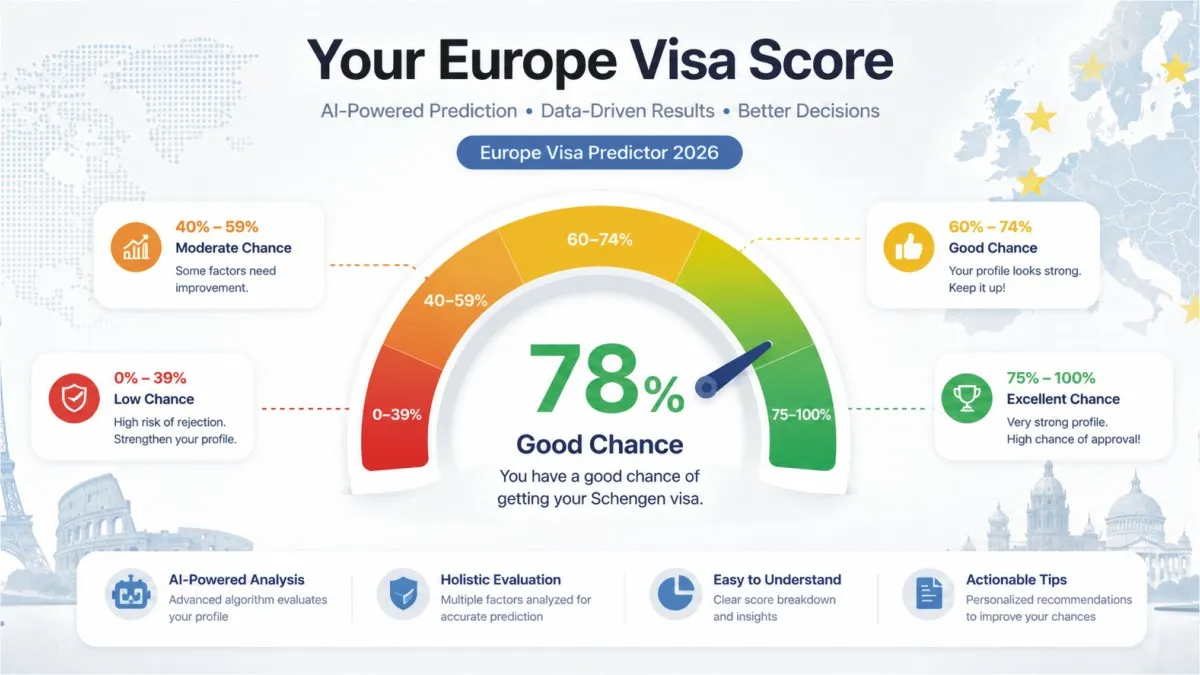
(Updated – May 27, 2026) Every year, millions of people from Pakistan, India, Nigeria, the Philippines, Egypt and dozens of other countries apply for a European tourist visa. Some are applying from their home country. Many others are living and working in the UAE, Saudi Arabia, Qatar, Oman or elsewhere in the Middle East and around the world.
No matter where they apply from, they all go through the same process — and many of them spend money on hotel bookings, flight reservations and visa fees — and then receive a refusal letter.
The refusal does not just cost money. It does not matter whether you paid those fees from Karachi, Lagos, Dubai or Riyadh — the loss is real, the refusal goes on your visa record, and it makes your next application harder.
The good news is that you do not have to apply blind anymore. You can now check your Europe visa approval chances before you spend a single dollar on your application — for free, in under two minutes.
This article explains exactly how to do that, what factors affect your chances and what you can do right now to improve your score before you apply.
Why Do So Many Europe Visa Applications Get Refused?
If you have ever received a visa refusal, you know how frustrating it feels. You did everything you thought was right. You filled the form, gathered documents, paid the fee — and still got refused.
The reason most applications fail is not dishonesty. It is a lack of understanding of what embassy officers are actually looking for.
Embassy officers do not read your application hoping to approve you. They are trained to look for risk. Their job is to identify applicants who might overstay their visa, work illegally, or not return home after their trip.
If your profile shows any of these risk signals — even unintentionally — your application gets refused.
The most common refusal reasons are:
Low bank balance. Your savings do not convincingly cover the cost of your trip plus a safe buffer for emergencies. A balance that only covers your exact trip cost is a red flag, not reassurance.
Weak home country ties. You cannot demonstrate strong reasons to return home. No stable job, no property, no dependent family — these all suggest to an officer that you might stay in Europe illegally.
No travel history. If this is your first international trip, embassies have no evidence of how you behave as a traveler. First-time applicants from high-scrutiny countries face extra examination for this reason.
Incomplete documents. Missing documents, dates that do not match between hotel bookings and flight reservations, insurance that expires one day early — these small mistakes cause outright refusals.
Previous refusals. If you have been refused before and you apply again without significantly improving your application, the officer sees the previous refusal note and refuses again.
Understanding these factors is the first step. The second step is knowing where your own profile stands before you apply.
How to Check Your Europe Visa Chances Before Applying
This is where most applicants used to be completely in the dark. You could read guides, ask on forums, or pay a consultant — but you had no way to objectively assess your own specific profile before submitting.
That has changed.
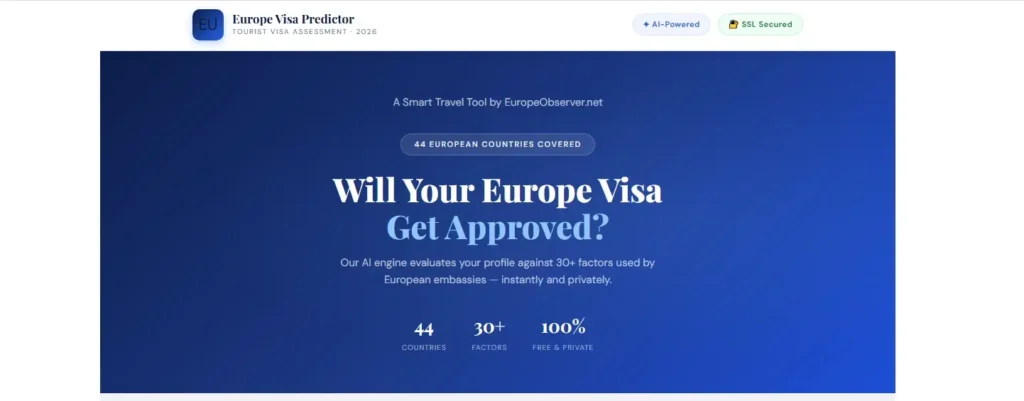
The Europe Visa Predictor 2026 is a free AI-powered tool that assesses your visa approval chances across all 44 European countries in under two minutes. It evaluates your profile across the same factors that embassy officers use — and gives you an honest probability score, a list of red flags in your application and specific suggestions for how to improve before you apply.
Check Your Europe Visa Chances Free →
Step by Step — How to Use the Europe Visa Predictor Tool
The tool works in four simple sections. You do not need to create an account. No personal data is stored. Everything is private.
Section 1 — Personal Profile
You fill in your nationality, country of residence, age, employment status, monthly income, savings, and travel history. You also answer questions about your home country ties — property ownership, business, family.
Be honest with every answer. The tool is designed to help you, not judge you. If you enter false information, your score will be inaccurate and the suggestions will not help you.
Section 2 — Travel Plan
You enter your destination country, planned travel dates, duration of stay, and details about your bookings — whether you have a confirmed hotel, confirmed flights, and travel insurance.
Section 3 — Financial and Ties Analysis
This section asks about your financial documents — bank statements, salary slips, tax returns — and your return obligation factors. Return obligation means the reasons you have to go back home after your trip. This includes your job, your family, your property, and your community ties.
Section 4 — Document Readiness
You tick which documents you currently have ready. The tool uses this to calculate your document score and identify which critical documents are missing.
Then click Analyse.
The tool takes a few seconds to process your profile and then shows you your full assessment.
Understanding Your Score — What the Results Mean
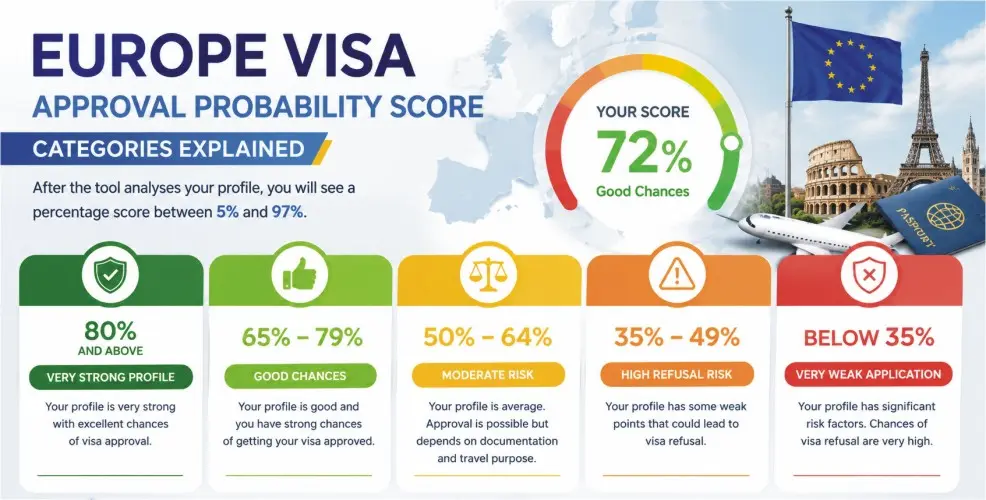
After the tool analyses your profile, you will see a percentage score between 5% and 97%. Here is what each range means:
80% and above — Very Strong Profile Your application has excellent foundations. You have strong finances, good travel history, solid home country ties, and complete documents. Apply with confidence, but still make sure every document is perfect before submitting.
65% to 79% — Good Chances Your profile is solid but has one or two areas that could be stronger. Read the improvement suggestions carefully and address the specific gaps the tool identifies before applying.
50% to 64% — Moderate Risk Your application has noticeable weaknesses. You could still get approved, but the risk of refusal is real. Do not apply yet. Work on the areas flagged as red flags first — particularly finances and home country ties.
35% to 49% — High Refusal Risk Your current profile would very likely result in refusal. This is not the time to apply. Use the suggestions to make significant improvements — increase your bank balance, gather stronger documents, build your travel history — before reapplying.
Below 35% — Very Weak Application Applying now would almost certainly result in refusal, which would then make your next application even harder. Take 3 to 6 months to seriously strengthen your profile before trying again.
What the Tool Checks — The 5 Scoring Factors
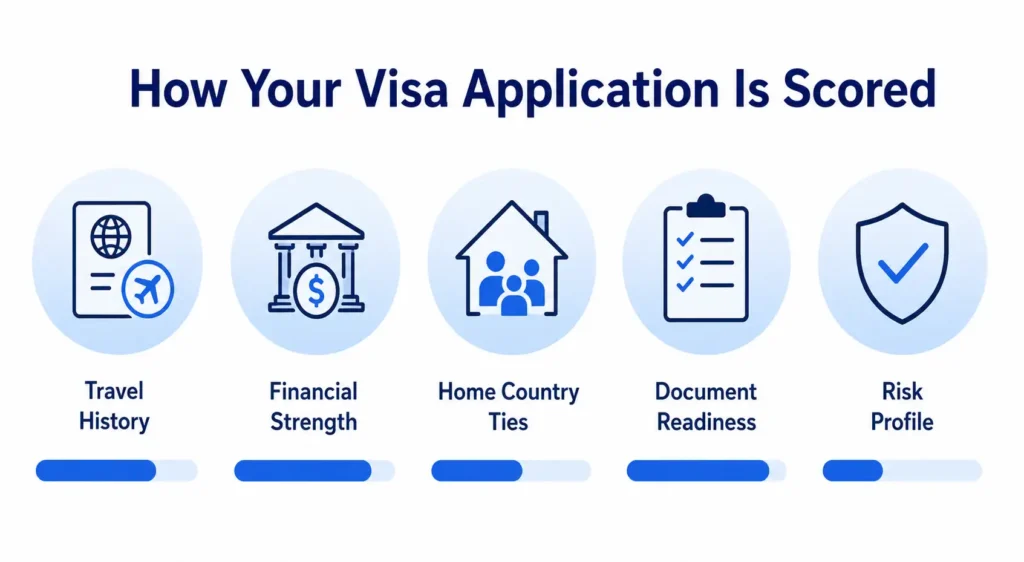
The Europe Visa Predictor assesses five main categories. Understanding each one helps you know exactly where to focus your energy.
- Travel History Score
This measures your international travel experience and your previous visa record. Applicants who have traveled to multiple countries and always returned home on time are considered lower risk. Previous Schengen or European visas carry particularly strong weight — they mean another European embassy already assessed and approved you.
If you have no travel history, this is your weakest factor. The tool will flag this and suggest ways to address it — including which countries to visit first to build your record before applying to Europe. - Financial Strength Score
This measures whether your income and savings are sufficient for your planned trip, and whether your financial history shows stability rather than sudden changes.
The tool compares your savings to your planned trip budget and checks your daily budget against embassy expectations. It also evaluates your employment income and whether your financial profile is consistent.
A bank balance that only appeared recently — from a sudden large deposit — is a warning sign even if the number looks good. Embassies want to see savings built over time. - Home Country Ties Score
This is often the deciding factor in borderline applications. It measures how compelling your reasons are to return home after your trip.
Strong ties include a stable long-term job, owned property, dependent family members, an active business, and long-term legal residence in your country. The more of these you have, the stronger your return obligation score.
If you are young, single, renting, and in a new job — your ties score will be weak even if your finances are strong. This is one of the most common reasons for refusals among applicants from Pakistan, India, and African countries. - Document Readiness Score
This measures how complete and well-prepared your application documents are. The tool checks all 12 standard required documents and identifies which critical ones are missing.
The six non-negotiable documents — passport, photos, bank statements, hotel booking, flight reservation, and travel insurance — are weighted most heavily. Missing any of these results in automatic score deductions. - Risk Profile Score
This factor accounts for elements outside your direct control — primarily your nationality and current residence status. Applicants from countries with historically high overstay rates face higher default scrutiny.
If your nationality falls into the high-scrutiny category, the tool will tell you. This does not mean you cannot get a visa. It means you need stronger evidence in all other categories to compensate.
What to Do If Your Score Is Low
A low score is not a reason to feel discouraged. It is genuinely useful information. It tells you exactly what to fix before spending money on an application that would likely be refused.
Here are the most effective actions based on common weak areas:
If your financial score is low: Do not apply yet. Open a dedicated savings account and build your balance consistently over 3 to 6 months. Aim for at least 1.5 times your total trip budget as a minimum. Avoid large unexplained deposits right before applying — officers recognize this pattern immediately.
If your home ties score is low: This is harder to fix quickly but not impossible. If you are employed, get a strong official letter from your employer confirming your position, salary, length of service, and approved leave dates. If you have any property interest — even partial family ownership — gather those documents. Write a detailed cover letter explaining your specific reasons to return home.
If your travel history score is low: Start building your travel record. Georgia, Serbia, Turkey, and Albania all have very accessible entry requirements for most nationalities. Even one or two stamps in your passport from neighboring countries shows you have traveled and returned. This directly improves your score on the next assessment.
If your document score is low: This is the easiest problem to fix. Go through the document checklist in the tool results and simply gather each missing item. Travel insurance in particular is one of the most overlooked documents — many applicants forget it until the last moment.
If your risk profile score is low due to nationality: You cannot change your nationality, but you can compensate for it. Applicants from high-scrutiny countries need to be stronger in every other category — particularly finances and ties. A score of 80%+ in financial strength and ties can overcome a weak nationality risk score.
Which European Country Should You Apply To?
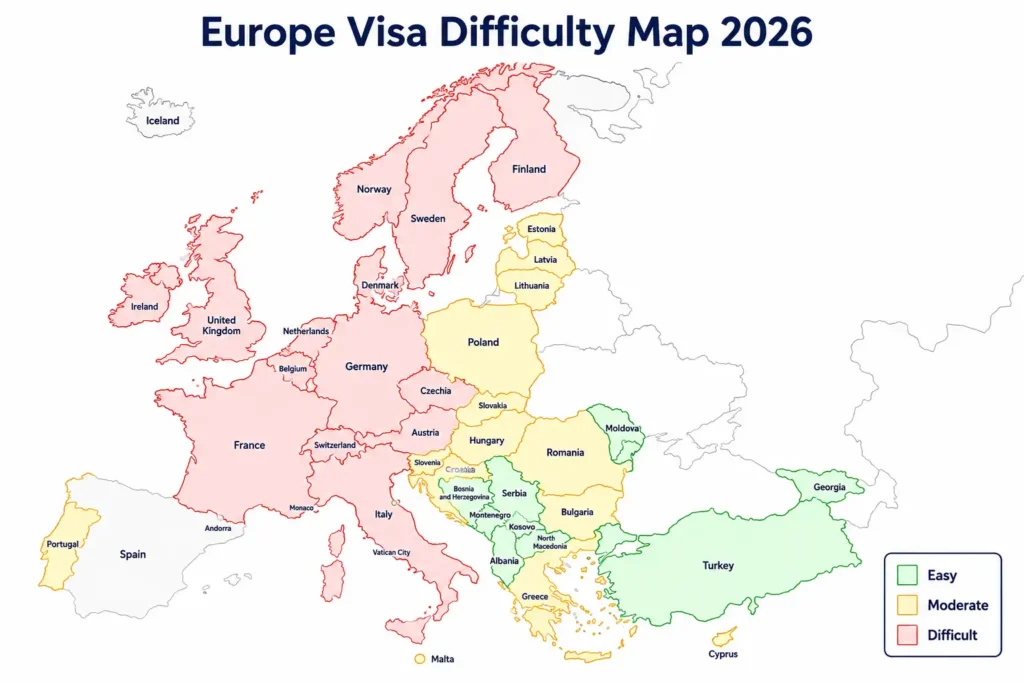
One of the most useful features of the Europe Visa Predictor tool is the country comparison table. After your assessment, it shows your approval probability across 12 different European countries — not just the one you selected.
This is important because the same applicant profile can have a 45% chance with Germany and a 78% chance with Greece. The destination you choose affects your approval probability significantly.
For first-time applicants and weaker profiles, these countries offer the best starting points:
Georgia requires no visa for many nationalities and has minimal entry requirements for those who do need one. An approved Georgian visit immediately adds to your travel history.
Serbia is visa-free for many nationalities and has straightforward entry for others. No minimum bank balance requirements at Schengen levels.
Albania and Montenegro are similarly accessible and ideal for building a first travel record in Europe.
Greece and Portugal are the most accessible Schengen entry points for first-time applicants with moderate profiles. Both have relatively flexible financial thresholds and high approval rates for genuine tourism applications.
Romania and Bulgaria joined the Schengen Area in 2024 and still process applications with accessible requirements. Both are excellent first Schengen visas for applicants working on building their European travel history.
For applicants with strong profiles:
Once you have one or two European visas approved and your profile is strong, you can confidently apply to France, Netherlands, Italy, and Spain with good approval chances.
Germany, Switzerland, Denmark, Norway, and Sweden require the strongest profiles — solid finances, clean travel history, strong ties, and complete documentation. These are best approached after establishing a European visa history.
The Smart Way to Plan Your First Europe Trip
If you are applying for a European visa for the first time, here is the strategy that gives you the best chance of success:
First — assess before you book anything. Use the Europe Visa Predictor tool before spending money on hotel reservations or flight tickets. Know your score. Read your red flags. Fix what you can.
Second — choose the right destination. Look at the country comparison table in your results. Apply to the country where your approval probability is highest, not necessarily your dream destination. You can visit your dream destination once you have built a visa history.
Third — prepare your documents completely. Do not submit an application until every document on the checklist is ready. One missing document can cause a refusal that damages all future applications.
Fourth — write a strong cover letter. Most applicants skip this. It is the single highest-impact document in a borderline application. A specific, honest, well-written cover letter that addresses your ties, your itinerary, and your financial situation can convert a borderline case into an approval.
Fifth — apply at the right time. Apply at least 6 to 8 weeks before your planned travel date. Do not apply during peak holiday seasons when processing is slower and officers are handling higher volumes.
Frequently Asked Questions
Is the Europe Visa Predictor tool free?
Yes. The tool is completely free to use. No account is needed and no personal data is stored. Your assessment is private.
How accurate is the tool?
The tool provides an estimated probability based on the same factors that embassy officers assess. It is not able to predict individual officer decisions, current processing volumes, or geopolitical factors. It is a preparation tool, not a guarantee.
Can I use the tool multiple times?
Yes. You can use it as many times as you want. Many applicants use it once to get their baseline score, make improvements to their profile, and then use it again to see how their score has changed before applying.
Does a high score guarantee visa approval?
No. A high score means your profile is strong relative to standard assessment criteria. Final decisions are always made by the relevant embassy or consulate based on their own assessment of your specific application.
My score is below 50%. Should I still apply?
We recommend not applying until your score is at least 60% to 65%. Applying with a weak profile risks a refusal that goes on your record and makes future applications harder. Take the time to improve your profile first.
I got refused before. Can I still get approved?
Yes — but your application needs to be significantly stronger than your previous one. The tool accounts for previous refusals in its scoring. Read the improvement suggestions carefully and make sure you address the specific reason for your previous refusal in your cover letter.
Check Your Europe Visa Chances Right Now
You now understand exactly what European embassies look for, how to assess your own profile, and what steps to take to maximize your approval chances.
The next step is simple.
Use the free Europe Visa Predictor tool to check your personal score right now — before you book anything, before you pay any fees, and before you risk a refusal on your record.
It takes under two minutes. It is completely free. And it could save you from a costly mistake.
Check Your Europe Visa Chances Free →
Important Notice
This article and the Europe Visa Predictor tool are provided for informational purposes only. Visa probability scores are estimates based on publicly available embassy assessment criteria and do not guarantee any outcome. Final visa decisions are made solely by the relevant embassy or consulate. This is not legal advice. Always verify current requirements with official embassy sources and consult a licensed immigration professional for complex situations.

Having 16 years of experience about Immigration, Visit Visa, Work Visa, Study Visa and Careers in Europe. We keep our eyes open and bring the latest and accurate content for our readers.