
Updated 17 November 2026 · By Europe Observer Team
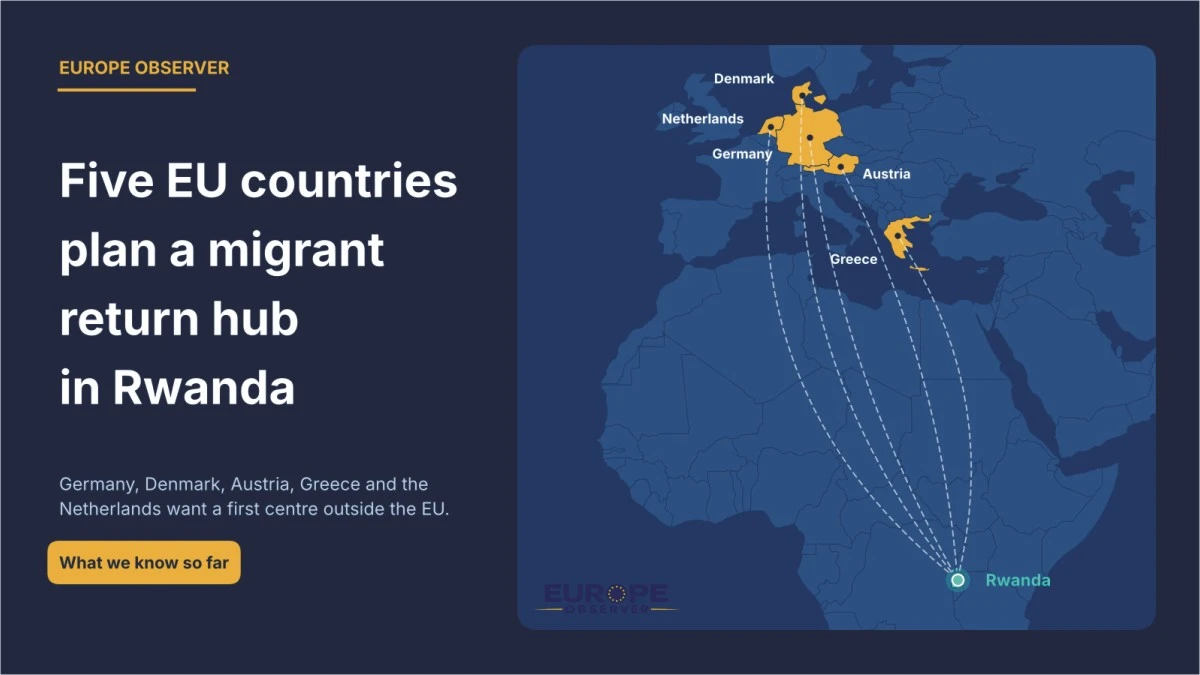
Germany, Denmark, Austria, Greece and the Netherlands want to open a “return hub” in Rwanda for migrants whose asylum claims were rejected. It would be the first centre of its kind outside the EU. The deal is not final yet, and it already divides Europe.
Key points
- The five countries presented the plan on Monday 16 November in Vienna, together with Rwandan officials.
- The centre is for people who have no right to stay in the EU and cannot be sent to their home country.
- Diplomatic sources say it would start as a small pilot of about 100 people. The countries hope to open it in 2027.
- Supporters say it gives governments control over migration. Critics say it could harm migrants’ rights.
What did the five countries announce?
On Monday, ministers from the five countries met in Vienna and unveiled the plan with senior officials from Rwanda. The Austrian chancellor, Christian Stocker, explained the idea in simple terms. If a person has no right to stay and cannot go back to their home country, they could be sent to a third country such as Rwanda.
The European Commission welcomed the news. A spokesperson said Brussels had been following the preparation of the plan closely.
What is a “return hub”?
A return hub is a centre in a country outside the EU. People whose asylum claims have been rejected can be sent there when their own country will not take them back.
Greece’s migration minister described the idea earlier this year in the same way. He said hubs would be for people whose asylum applications are rejected and whose home countries refuse to accept them.
This is not a new idea in politics. But until now, no EU country had a deal for a centre like this outside the bloc.
How big will it be, and when will it open?
The details are still unclear. According to diplomatic sources, the Rwanda hub would begin as a pilot. It would host around 100 people, and each of the five countries might send about 20 migrants.
The countries say they hope to have the centre running in 2027. The agreement itself has not been finalised yet, so dates and numbers could change.
Why is this happening now?
The EU changed its migration rules this year. The new rules allow governments to set up centres outside the EU, either alone or in small groups. The European Parliament voted for this in June.
The number of people arriving in the EU has also been falling for three years. The bloc has made deals with countries in Africa and the Middle East to reduce departures. Still, migration remains a big political issue in many European countries, and governments want to send more rejected applicants home.
What do supporters say?
- Denmark: Prime Minister Mette Frederiksen called the centre a “very modern” idea. She said controlling who enters and who must leave is a value she believes in.
- Germany: Interior Minister Alexander Dobrindt said the plan would follow human rights and both European and German law.
- Rwanda: Interior Minister Vincent Biruta said the plan offers “a second chance” to people who can no longer stay in the partner country.
The five governments say the plan fits EU and international law.
What do critics say?
- Spain: Prime Minister Pedro Sánchez said the plan has no “future or humanity.”
- Human rights groups: 45 NGOs from 15 countries criticised the move. The UN refugee agency, UNHCR, also warned against it. Rights groups say the plan could break migrants’ rights.
- Rwanda’s record: Some groups worry about sending people to Rwanda because of its human rights image. Biruta said that image is a cliché.
- Children: The International Organization for Migration (IOM) said it is talking with some EU countries about return hubs. It also said unaccompanied children should not be sent to one.
How is this different from Britain’s Rwanda plan?
In 2022, Britain agreed a deal with Rwanda to send irregular migrants there before their asylum claims were heard. London later cancelled it.
The new EU plan is different on paper. It is meant for people whose asylum claims have already been rejected, not for people still waiting for a decision.
The UK is watching closely. Prime Minister Andy Burnham said last week that Britain is following the European plan “with interest” while it thinks about its own next steps.
Rwanda has also received migrants from the United States under a similar scheme supported by President Donald Trump.
What happens next?
- The five countries and Rwanda still need to finalise the agreement.
- The pilot is expected to start in 2027, if the deal goes ahead.
- Rights groups are likely to keep challenging it, so legal and political debates may continue.
We will update this article when new details come out.
Frequently asked questions
- Which countries are behind the plan? Germany, Denmark, Austria, Greece and the Netherlands.
- Is the Rwanda centre open now? No. The countries hope it will open in 2027, and the agreement still has to be finalised.
- Who would be sent there? People whose asylum claims were rejected and who cannot be returned to their home country.
- Why do critics oppose it? They say it could violate migrants’ rights and worry about Rwanda’s human rights record.
- Is it the same as the UK’s Rwanda plan? No. The UK plan, agreed in 2022 and later cancelled, was about people whose claims had not yet been decided. The EU plan is for rejected claims.
Sources
- AFP via France 24: “Five EU nations unveil migrant deportation centre deal with Rwanda,” 16 November 2026
- AFP via The Korea Herald: “Five European nations plan Rwanda hub,” 16 November 2026
- RTÉ: “Five EU nations unveil Rwanda deal for migrant return hub,” 16 November 2026
- BNN: “Five EU countries plan to establish centre for rejected asylum seekers in Rwanda”
- Associated Press via Yahoo News: “Greece working with another 4 European countries to set up migrant deportation hubs outside EU”

M. Arshad is a Senior Correspondent specializing in EU-South Asian migration policy and international labor corridors, with over 12 years of experience reporting on bilateral trade agreements.