
A representative account based on real applicant experiences · Updated May 31st, 2026 · 9 min read
Ahmed Raza had been working as a civil engineer in Dubai for six years. He had a stable job, a good salary, money saved in his account and three weeks of annual leave approved by his employer. He had been planning a Europe trip for two years.
But before he paid for anything — before the hotel deposits, before the flight reservations, before the visa fee — a colleague at work said something that stopped him.
“Did you check your visa chances first? A lot of guys from our office applied and got refused. One of them had better savings than you.”
Ahmed had not checked anything. He assumed that six years of stable employment in Dubai, a decent bank balance and a genuine reason to travel would be enough. He was about to find out how wrong that assumption was — and how right it was to find out before applying.
The Tool His Colleague Mentioned
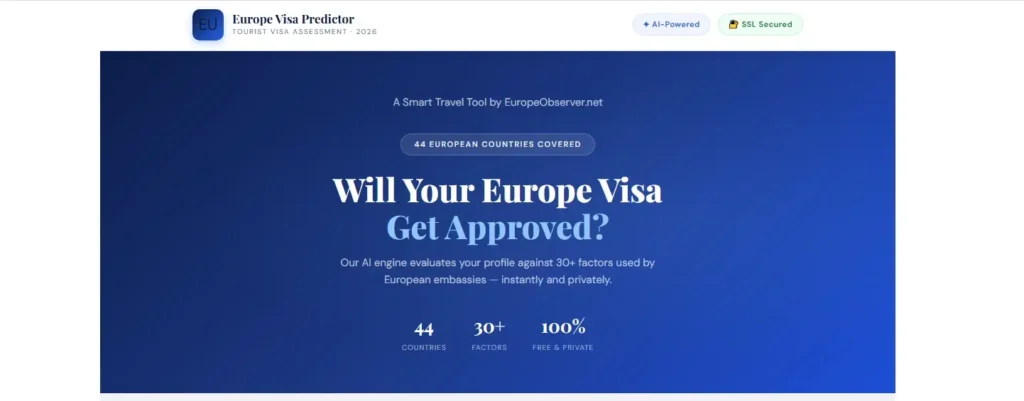
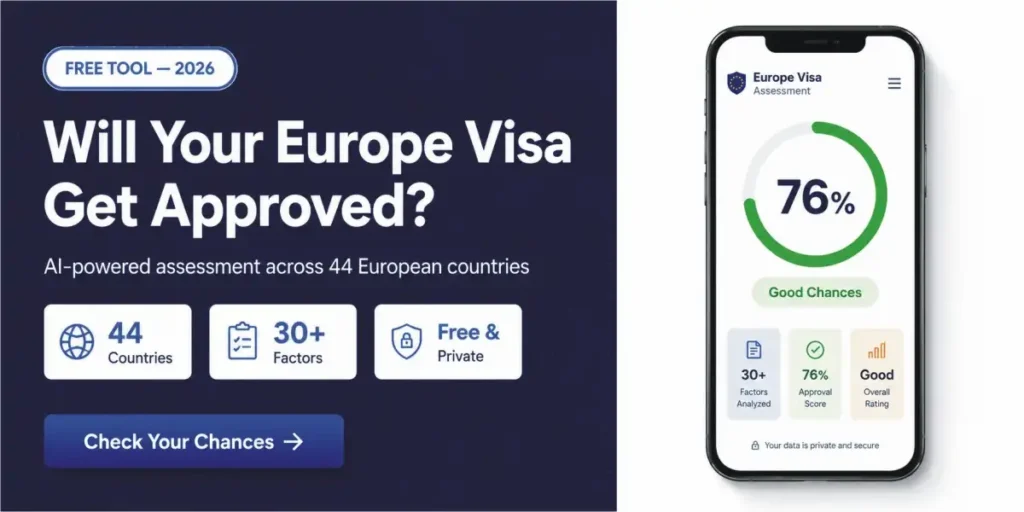
His colleague sent him a link to the Europe Visa Predictor 2026 — a free AI-powered tool that assesses your visa approval chances across all 44 European countries before you apply.
“I thought it would be one of those basic tools that just asks your nationality and gives everyone the same generic answer” he said. “I was not expecting it to actually tell me something useful.”
Check Your Europe Visa Chances Free → HERE
He opened the tool on his phone during his lunch break. It asked him to fill in four sections — his personal profile, his travel plan, his financial and document details and his document readiness. No account needed. No personal data stored. The whole thing took him about seven minutes to complete honestly.
Then his result appeared.
CHECK YOUR CHANCES OF EUROPE VISA APPROVAL
His First Score — Not What He Expected
62%
Ahmed stared at the screen for a moment.
He had expected something in the high seventies at minimum. He had a job. He had savings. He had approved leave. He was a genuine tourist with genuine intentions.
Sixty two percent.
The tool categorized his profile as Moderate Risk — meaning his application had real weaknesses that could result in refusal, and that applying in his current situation was not recommended.
“I was honestly a bit shocked,” he said. “I thought my situation was strong. I had more savings than most of my colleagues who applied. But the score was telling me something different.”
He scrolled down to read why.
Surprise Number One — His Travel History
The first red flag on Ahmed’s result was one he had not thought about at all.
No prior travel history.
In six years of living and working in Dubai, Ahmed had traveled back to Pakistan for Eid and family visits — but he had never traveled internationally for tourism. No other country stamps in his passport. No previous visas from any country other than his UAE residence visa.
The tool flagged this clearly:
“No international tourism travel history detected. First-time international tourism applicants from high-scrutiny nationalities face significantly elevated refusal risk. European embassies have no evidence of your travel behavior or return compliance.”
Ahmed had never considered this. He thought his UAE residence — six years of legal, stable residence in one of the world’s wealthiest countries — would count in his favor.
It did count. But not enough to compensate for zero tourism travel history.
The tool’s suggestion was direct: before applying to a Schengen country, build at least one or two international tourism stamps in your passport. Georgia, Serbia, and Turkey were specifically mentioned as highly accessible first destinations that would immediately strengthen his travel history score.
“I had honestly never thought about going to Georgia or Serbia. But the tool explained that even one stamp showing I traveled somewhere and came back would significantly improve my score. It made sense when I read it.”
Surprise Number Two — His Bank Balance
Ahmed had approximately AED 28,000 in his account — roughly $7,600 USD. For a three-week trip to France, Italy, and Spain, he calculated this was more than enough.
The tool agreed that the balance itself was adequate.
But it flagged something he had not anticipated.
His bank statement pattern.
Two months before running the assessment, Ahmed had received a bonus from his company. He had also transferred money from a savings account into his current account — making his balance look suddenly much higher than it had been in previous months.
The tool identified this pattern as a potential red flag:
“Bank balance shows a significant recent increase not consistent with previous months’ activity. Embassy officers are trained to identify sudden balance changes as potential borrowed funds. Three to six months of consistent balance history is significantly more convincing than a high current balance with irregular history.”
Ahmed had not borrowed any money. The balance was completely legitimate. But from an embassy officer’s perspective, looking at three months of statements showing a sudden jump, it could look suspicious.
“This was the most surprising thing the tool told me. I had real money. It was my bonus and my own savings. But the timing made it look questionable on paper. I had no idea embassy officers looked at this.”
The tool’s suggestion: wait three months before applying, keep the balance consistent, and avoid any large movements in or out of the account in the months before the application.
Surprise Number Three — His Dream Destination Was His Worst Choice
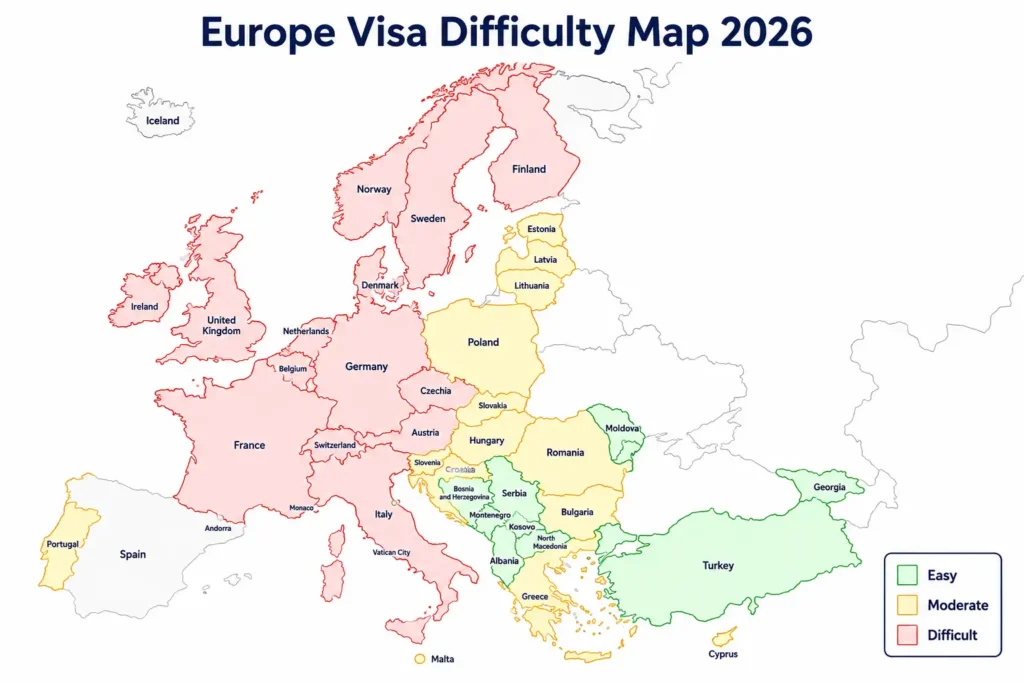
Ahmed wanted to visit France, Italy, and Spain — specifically in that order, starting with Paris.
Since France was his first destination and where he would spend the most days, he would need to apply to the French consulate. The tool’s country comparison table showed his approval probability broken down by country.
The results were striking:
| Country | Visa Approval Chance |
|---|---|
| 🇬🇪 Georgia | 89% |
| 🇬🇷 Greece | 74% |
| 🇵🇹 Portugal | 71% |
| 🇭🇷 Croatia | 68% |
| 🇵🇱 Poland | 67% |
| 🇪🇸 Spain | 58% |
| 🇮🇹 Italy | 57% |
| 🇫🇷 France | 54% |
| 🇳🇱 Netherlands | 51% |
| 🇩🇪 Germany | 43% |
| 🇨🇭 Switzerland | 38% |
France — his dream starting point — was near the bottom of his personal probability list.
Greece and Portugal, which he had not seriously considered, were at the top of his Schengen options with approval probabilities of 74% and 71% respectively.
“Seeing it laid out like this was eye-opening. I knew some countries were stricter than others but I did not know the difference would be this big for my specific profile. France at 54% versus Greece at 74% — that is a massive gap.”
The tool explained why. France applies medium-high scrutiny to first-time Schengen applicants from Pakistani nationality with no prior European visa history. Greece, as one of the most tourism-dependent economies in Europe, applies relatively flexible financial thresholds and processes high volumes of first-time applications with less rigid risk profiling.
The suggestion was clear: apply to Greece first. Build your Schengen history. Then apply to France on a future trip when you already have a Schengen approval on your record.
Surprise Number Four — Missing Document
Ahmed’s document readiness score was decent — he had most of what he needed. Employment letter, bank statements, passport photos, hotel booking plan, flight itinerary plan.
But the tool flagged one critical missing document.
Travel insurance.
Ahmed had planned to buy travel insurance after his visa was approved. He thought this was the logical order — get the visa first, then arrange insurance for the confirmed trip.
This is one of the most common misconceptions among first-time Schengen applicants.
Travel insurance is a mandatory submission document for a Schengen visa application — not something you arrange after approval. It must cover a minimum of €30,000 in medical expenses and repatriation, must be valid for the entire Schengen area, and must cover every single day of your planned stay including arrival and departure dates.
Without it, your application is rejected at intake — before an officer even looks at your finances or travel history.
“I genuinely did not know this. I thought you buy insurance for the trip, not for the visa application. If I had submitted without it, I would have been refused immediately and it would have gone on my record as a refusal.”
“The tool basically gave me a roadmap. I was not happy that my score was 62% but I was very happy I found out before I applied and got refused. A refusal would have set me back much further than a few months of preparation.”
What Ahmed’s Experience Teaches Every Applicant
Ahmed’s story is not unusual. Thousands of Pakistani, Indian and other nationality applicants in the UAE, Saudi Arabia, Qatar and Oman go through almost exactly the same experience every year — strong intentions, adequate finances on the surface but hidden weaknesses they did not know existed.
The four surprises in Ahmed’s assessment are the four most common blind spots among applicants from this region:
- Travel history is more important than most people realize. A UAE residence visa is not a travel history. International tourism stamps are what embassy officers look for.
- Bank balance history matters as much as the balance itself. Consistent, stable, growing savings over three to six months is worth more than a high current balance that appeared recently.
- Your dream destination and your best strategic destination are often different. The smart move is to start where your approval chances are highest and build toward where you want to go.
- Travel insurance is a submission document, not a post-approval purchase. This single misunderstanding causes thousands of unnecessary refusals every year.
Check Your Own Score Before You Apply
If you are planning a Europe trip — from Pakistan, from the UAE, from Saudi Arabia, from anywhere — the single most valuable thing you can do before booking anything is run your own assessment.
It takes under two minutes. It is completely free. No account needed and no personal data stored.
You might find out your profile is stronger than you thought. Or you might find out — like Ahmed did — that there are specific, fixable issues that are worth addressing before you spend money on an application.
Either way, you will know exactly where you stand.
Check Your Europe Visa Chances Free → HERE
The Europe Visa Predictor 2026 covers all 44 European countries, assesses 30+ factors, shows your approval probability by country, identifies red flags in your specific profile, and gives you personalized suggestions for improvement.
Important: Ahmed Raza contacted our team via email and shared his real experience and visa assessment outcomes. This article is for informational purposes only. Visa probability scores generated by the Europe Visa Predictor tool are estimates based on publicly available embassy assessment criteria and do not guarantee any visa outcome. Final decisions are made solely by the relevant embassy or consulate. Always verify current requirements with official sources. Consult a licensed immigration professional for complex situations.

J. Maham is a specialized travel and immigration analyst with a focus on European work permits and South Asian’s mobility. With over 5 years of experience tracking global visa policy shifts, Maham provides verified, actionable insights for professionals seeking legal pathways to the EU and beyond.
J. Maham, My name is Ansar Abbas, son of Liaqat Ali, resident of Garden Town, Street No. 01, Dunga Bunga, Tehsil and District Bahawalnagar, Pakistan. I have applied for a free Romanian visa for a labor worker, a fruit picker. Please help me.