
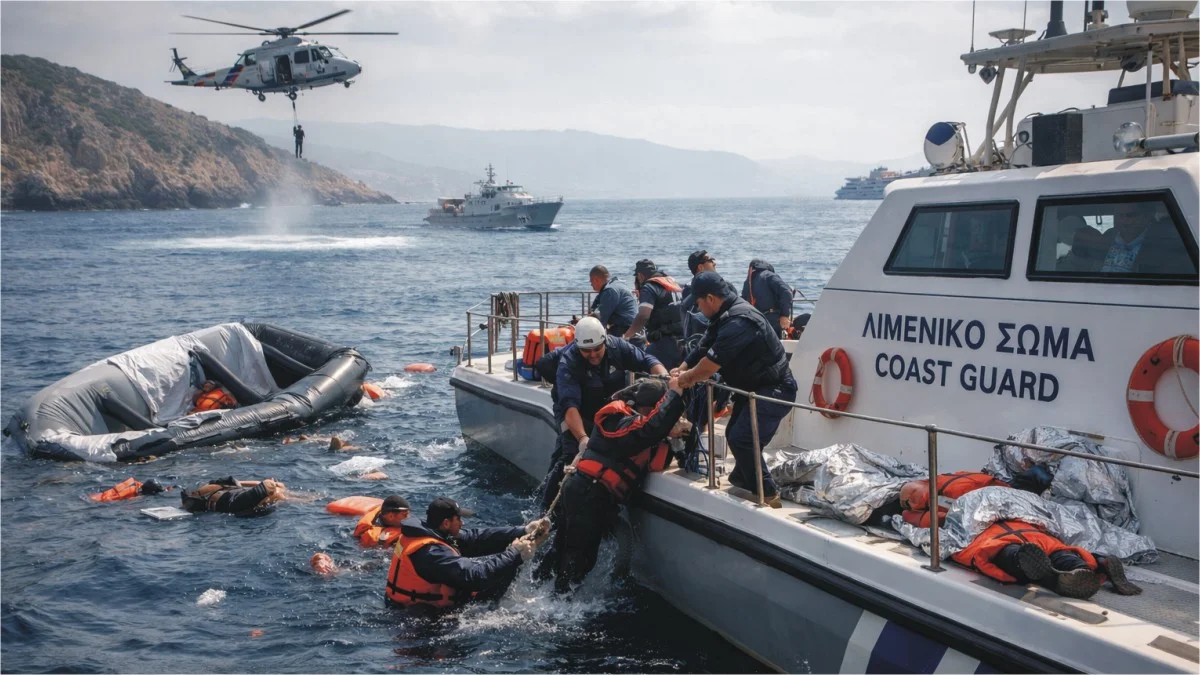
Greece – February 04, 2026, Today, Greek authorities are dealing with the aftermath of a deadly migrant boat collision in the Aegean Sea that has killed at least 15 people and placed renewed pressure on the country’s maritime border system.
The incident occurred late Tuesday night in the narrow waters off the island of Chios, close to the eastern maritime boundary of Greece. A speedboat carrying foreign passengers collided with a Greek coast guard patrol vessel during an active sea operation. The smaller boat capsized and sank, throwing those on board into the water.
Rescue teams worked through the night and into Wednesday morning. By daylight, officials confirmed that at least 15 people had died. Search operations continued as authorities said others were still missing.
Rescue Operation and Official Response
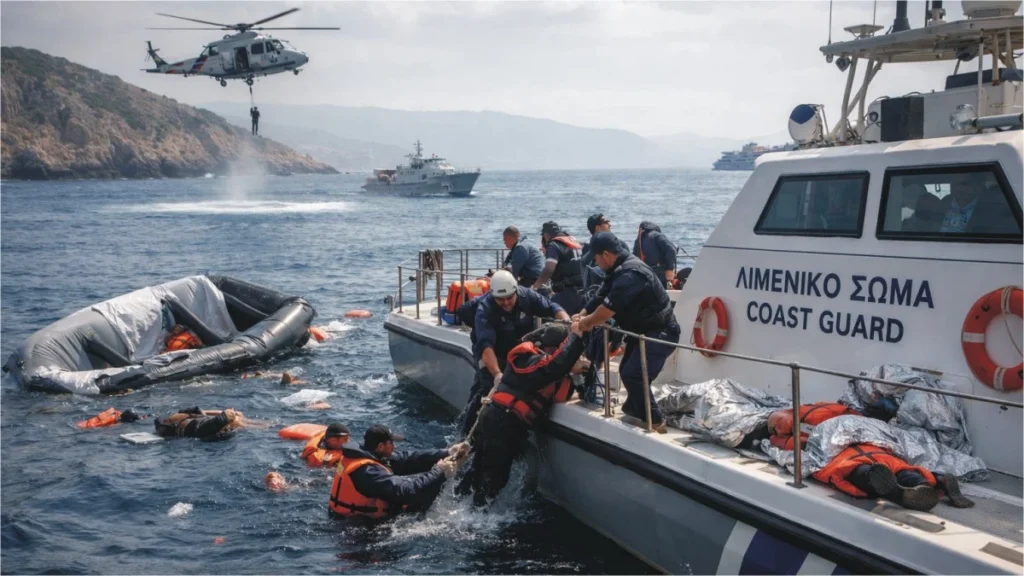
The Hellenic Coast Guard said multiple patrol vessels, a helicopter, and civilian divers were deployed in the search area near Myrsinidi beach. Naval units in the wider region were placed on alert under Greek coordination, and a navigational warning was issued for nearby waters.
Survivors were taken to Skylitseio Hospital in Chios, where doctors treated patients for severe injuries, cold exposure, and trauma. Hospital officials confirmed that one injured woman died after arrival, adding to the death toll. Two coast guard officers were also hospitalized following the collision, with one later discharged.
Authorities said recovered bodies were transferred for autopsies as part of a formal investigation led by the Central Port Authority of Chios. The inquiry is examining vessel movements, patrol conditions, and the sequence of events that led to the crash.
Nationalities Identified
Greek officials confirmed that most of the passengers on the sinking speedboat were Afghan nationals. At least one Moroccan national has also been identified among the survivors. Authorities believe around 39 people were on board at the time of the collision.
Hospital records show that those receiving treatment include men, women, and minors. Officials said several patients required surgery for serious injuries. Medical teams described the condition of some survivors as critical during the first hours after the rescue.
The identification process is ongoing, and officials cautioned that figures may change as investigations continue and missing persons are accounted for.
Pressure on Greece’s Sea Border System
The collision highlights growing strain on Greece’s maritime enforcement and rescue systems in the eastern Aegean. The waters around Chios are among the most heavily monitored areas in Europe, forming part of a frontline maritime boundary of the European Union.
Analysts note that these narrow sea corridors concentrate patrol vessels, fast-moving boats, and limited reaction time in confined spaces. When overloaded boats enter these zones, the risk of fatal incidents rises sharply, especially during night operations.
Greek authorities have expanded patrol activity in recent years as irregular sea movements persist in the region. Each incident places simultaneous demands on enforcement, rescue coordination, medical services, and legal investigations.
Wider European Implications
European officials view such events as more than isolated maritime accidents. Fatal collisions and sinkings are seen as indicators of systemic pressure across the EU’s external sea borders, where responsibility for enforcement and rescue often falls on a small number of frontline states.
Incidents in the Aegean regularly prompt discussions within European institutions about coordination, burden sharing, and maritime safety. They also draw attention to the operational risks faced by coast guard crews working in high-density and high-stakes environments.
The Greek navy’s decision to place vessels on standby reflects how quickly local incidents can escalate into broader, multi-agency responses with regional significance.
What This Signals Going Forward
The investigation into the Chios collision is ongoing, and Greek authorities are expected to review patrol procedures and maritime safety measures once initial findings are complete. For now, the focus remains on recovery efforts, medical care for survivors and accounting for those still missing.
Check Out
M. Arshad is a Senior Correspondent specializing in EU-South Asian migration policy and international labor corridors, with over 12 years of experience reporting on bilateral trade agreements.