
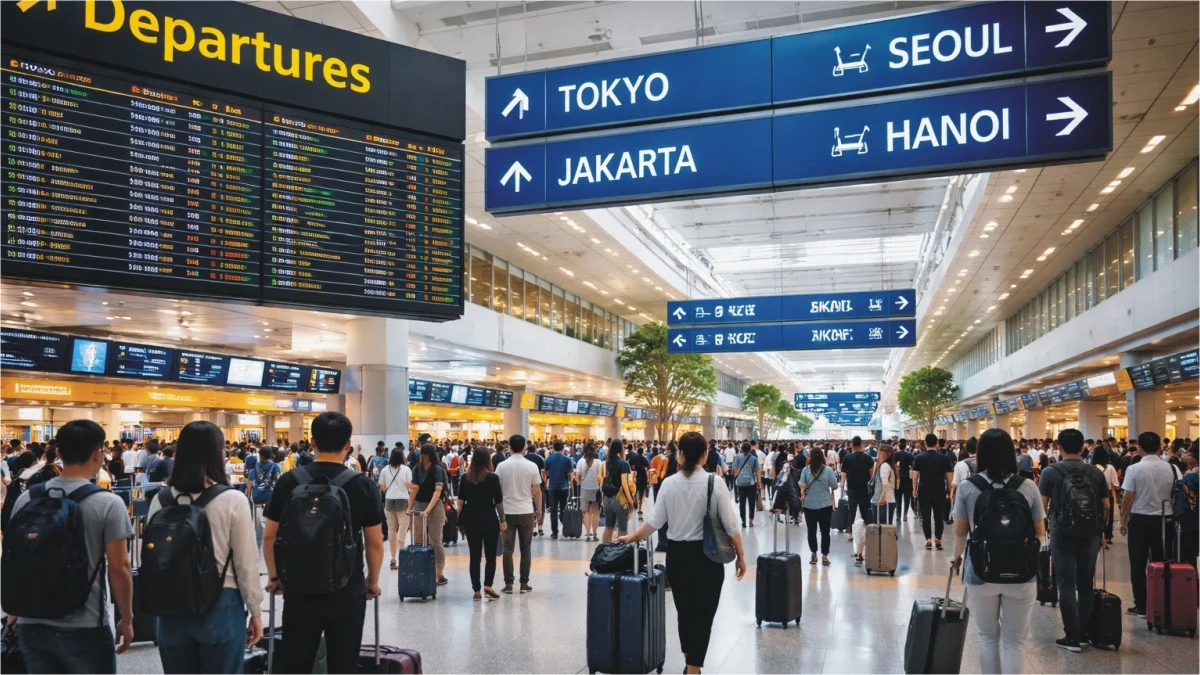
Today new tourism industry data shows a clear shift in global travel power. Asia has moved ahead of Europe and North America as the main driver of international travel demand in early 2026. Governments, airlines, and tourism systems across the region are now shaping how and where the world moves.
The change is structural, not seasonal. Analysts say it reflects deeper pressure inside Western travel markets and a coordinated rebound across East and Southeast Asia.
Asia Takes Nearly One Third of Global Demand
Fresh data from travel intelligence firm Mabrian places Asia at 31.7 percent of global international travel demand in the first half of 2026. That share is the highest recorded for the region in more than a decade.
By contrast, demand linked to Europe and North America is flat or slightly lower compared with early 2025. Industry observers point to capacity limits, high costs, and public backlash against mass tourism in major Western cities.
The result is a clear rebalancing. Asia is no longer a secondary option in global travel flows. It is now the core system.
Indonesia Joins Asia’s Top Tier
One of the most notable shifts is Indonesia’s rise into Asia’s top group, alongside Japan, China, South Korea, Vietnam, and the Philippines.
Officials in Jakarta have spent years pushing tourism beyond Bali. In 2026, that strategy is showing results. Air traffic data shows strong growth to secondary hubs such as Labuan Bajo in East Nusa Tenggara and Lake Toba in North Sumatra.
Industry sources say Indonesia is now being treated by airlines and tour operators as a long stay market, not a short holiday stop. This places new strain on airports, regional transport, and local housing systems.
Japan Faces Scale Pressure Beyond Tokyo
Japan remains Asia’s single largest draw, accounting for 16.3 percent of total global travel demand on its own. That figure is higher than any single European country.
But the pattern inside Japan is changing. Visitor flows are spreading away from Tokyo, Kyoto, and Osaka toward cities such as Fukuoka, Sapporo, and Sendai.
Government data shows this shift is easing pressure in historic centers while moving demand into regions with weaker infrastructure. Local authorities are now racing to expand transport capacity and crowd control systems before peak summer travel.
Vietnam and the Philippines Accelerate
Across Southeast Asia, Vietnam and the Philippines are posting some of the fastest growth rates in 2026.
In Vietnam, rising interest is reshaping air traffic toward Da Nang, Phu Quoc, and Nha Trang, not only Hanoi and Ho Chi Minh City. Hotel investment has followed, with dozens of mid scale and high end projects now under construction.
In the Philippines, demand is spreading across island regions beyond Boracay and Palawan. Tourism officials say this is changing domestic flight patterns and putting new pressure on ferry and port systems.
Air Capacity Recovery Reaches a Tipping Point
A key driver behind Asia’s surge is aviation. International air capacity to Asia is up 5.9 percent year on year in early 2026. For the first time since the pandemic, capacity now exceeds 2019 levels.
Major carriers in Japan, China, South Korea, and Southeast Asia have restored wide body routes while adding new regional links. This has tightened competition for aircraft and airport slots across the region.
Aviation analysts warn that congestion risks are rising, especially at hubs such as Tokyo Haneda, Seoul Incheon, Bangkok Suvarnabhumi, and Jakarta Soekarno Hatta.
Western Cities Lose Ground
At the same time, Western destinations are facing visible pushback. Cities including Barcelona, Venice, Amsterdam, and Paris continue to deal with public protests and tighter crowd controls.
Travel sentiment data shows growing resistance to peak season travel in these locations. This has redirected long haul demand toward Asia, where capacity expansion is more active and political pressure is lower.
Industry observers describe this as an anti concentration effect rather than a rejection of the West.
China’s Policy Moves Reshape Regional Flows
Another factor reshaping the map is China’s expanding visa free access for several European states, including France, Germany, and the United Kingdom.
While the policy is China focused, analysts say it has produced a regional spillover. Long haul visitors entering East Asia are increasingly adding nearby countries to the same journey, boosting demand across South Korea, Japan, and Vietnam.
Officials across the region are now coordinating more closely on air links and border systems to manage this spillover effect.
A System Wide Shift, Not a Trend
Travel economists stress that this is not a short term boom. Asia’s share of global travel intent has risen steadily for three years, while Western markets have plateaued.
The shift reflects demographics, infrastructure investment, and state level tourism planning. It also mirrors broader changes in global economic gravity.
For airlines, hotels, and governments, Asia is now the primary arena where growth, strain, and policy risk are concentrated.
What Comes Next
Looking ahead, analysts expect Asia’s share of global travel demand to remain above 30 percent through late 2026. The main question is whether infrastructure and regulation can keep pace with volume.
Pressure points are already emerging around housing, transport, and environmental limits in several destinations. How governments respond will shape the next phase of global travel flows.
For now, the direction is clear. In 2026, Asia is no longer catching up. It is setting the pace.
Check Out




Having 16 years of experience about Immigration, Visit Visa, Work Visa, Study Visa and Careers in Europe. We keep our eyes open and bring the latest and accurate content for our readers.